When Eight-Year-Olds Taught Algebra: The One-Room Revolution That Shaped America
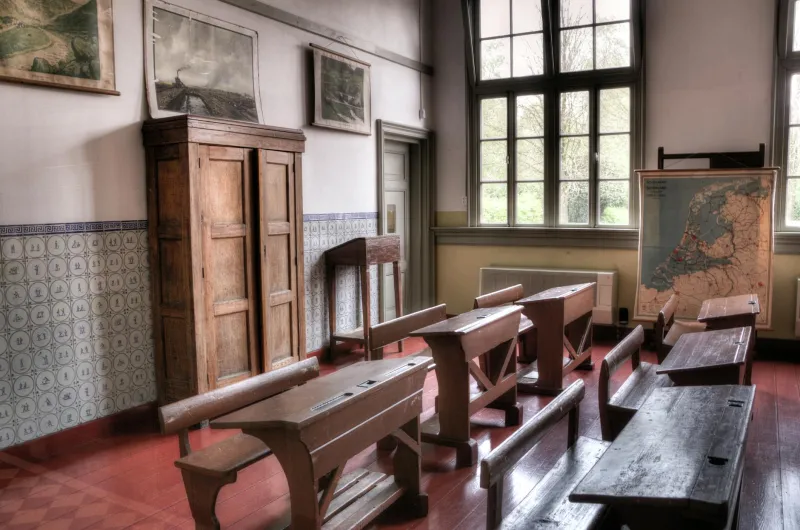
The Classroom That Defied Logic
Imagine walking into a schoolroom where a 14-year-old helps a 6-year-old with reading while simultaneously working through geometry problems. Where the same teacher manages first-graders learning their letters and eighth-graders tackling Shakespeare. Where children routinely teach each other, grade papers, and take genuine responsibility for their education.
This wasn't educational chaos. This was the one-room schoolhouse, and it worked better than most modern Americans would believe possible.
When Age Was Just a Number
Between 1870 and 1920, over 200,000 one-room schools educated rural America. These weren't quaint educational experiments—they were practical solutions that produced remarkable results. Students learned at their own pace, advanced when ready, and helped others along the way.
The typical one-room school housed 20-30 students ranging from age 5 to 16, all under the guidance of one teacher who often wasn't much older than her oldest students. The arrangement forced everyone to become both learner and teacher, creating an educational ecosystem that modern pedagogy is only beginning to rediscover.
Older students naturally became mentors and tutors. A 12-year-old who'd mastered long division would help struggling 8-year-olds, reinforcing his own understanding while developing teaching skills. This wasn't formal peer tutoring—it was organic academic community where helping others helped yourself.
The Democracy of Self-Reliance
One-room schools operated on principles that would shock modern educators. Students were expected to manage their own learning, moving through subjects at individual paces rather than lockstep grade-level progression. A bright 10-year-old might work on high school mathematics while still developing elementary writing skills.
The teacher functioned more like a learning conductor than a lecturer. She'd start the day by assigning work to each age group, then rotate between students, checking progress, answering questions, and providing individual instruction. Students learned to work independently, help each other, and take responsibility for their education.
Discipline was largely self-governed. Older students helped maintain order, understanding that disruption hurt everyone's learning. The mixed-age environment created natural social hierarchies based on maturity and academic achievement rather than arbitrary grade divisions.
When Learning Had No Speed Limit
The one-room model allowed exceptional students to flourish without artificial constraints. Gifted children could advance through multiple grade levels in a single year, while slower learners received individualized attention without the stigma of "falling behind" their age peers.
Textbooks were shared resources rather than grade-specific assignments. A student might use the same arithmetic book for two years, mastering concepts thoroughly before moving on. Others might race through multiple texts in a single semester. Progress was measured by mastery, not time spent in seat.
This flexibility extended to subject matter. Students often pursued interests that wouldn't fit modern curriculum standards. A farm boy fascinated by weather might study meteorology alongside his regular lessons. A girl interested in literature might read advanced texts while still working on basic mathematics.
The Teacher Who Wore Every Hat
One-room schoolteachers were educational entrepreneurs by necessity. They taught every subject to every grade level, managed discipline, maintained the building, and often boarded with local families. Most were young women in their teens or early twenties, armed with little more than high school education and fierce determination.
These teachers developed remarkable skills in individualized instruction because they had no choice. With 30 students at different levels, lecturing to the whole group was impossible. Instead, they mastered the art of quick assessment, targeted intervention, and peer-to-peer learning facilitation.
The job required creativity and resourcefulness that modern teachers, supported by specialists and technology, rarely need to develop. One-room teachers created their own materials, designed their own curricula, and solved educational problems through innovation rather than administrative support.
The Social Laboratory
One-room schools functioned as complete social systems where children learned life skills alongside academics. Older students naturally became leaders and role models. Younger children learned by observing and imitating their elders. The age mixing created family-like relationships that extended beyond school hours.
Conflict resolution happened in real time with real consequences. When disagreements arose, students had to work things out themselves or appeal to the teacher who knew everyone's personality and history. There were no guidance counselors, social workers, or behavioral specialists—just human beings learning to get along.
The schools reflected their communities directly. Parents knew the teacher personally, often hiring and supervising her themselves. Education wasn't separated from daily life—it was integrated into the fabric of rural community existence.
The Modern Transformation
Today's educational system represents the opposite philosophy: age-based grade levels, subject-specific teachers, standardized curricula, and institutional management. We've gained professional specialization, advanced resources, and systematic quality control. We've also lost much of what made one-room schools surprisingly effective.
Modern students rarely teach each other formally. Age segregation prevents the natural mentoring relationships that once flourished. Individual pacing has been replaced by grade-level standards that advance everyone together, regardless of mastery or readiness.
The institutional complexity that replaced one-room simplicity employs armies of specialists: reading teachers, math coaches, special education coordinators, behavioral interventionists, technology integrators, and curriculum specialists. This expertise comes at the cost of the holistic, relationship-based learning that characterized rural education.
What We Lost in the Consolidation
When America consolidated its schools in the name of efficiency and modernization, we gained professionally trained teachers, specialized programs, and educational resources that one-room schools couldn't provide. We also lost educational intimacy, student responsibility, and the natural peer teaching that helped both struggling and gifted learners.
The one-room model's greatest strength was its assumption that children could handle significant responsibility for their own learning and their classmates' success. Modern education, despite its sophisticated understanding of child development, rarely trusts students with that level of autonomy and interdependence.
Perhaps most importantly, we lost the educational flexibility that allowed children to learn at their own pace without the stigma of grade retention or the boredom of artificial advancement restrictions. The one-room schoolhouse trusted that children would learn when they were ready, with help from whoever was available to teach them.