Chalk, Smoke, and Brotherhood: When Every Town Had Its Democratic Pool Hall
The Democracy of the Green Felt
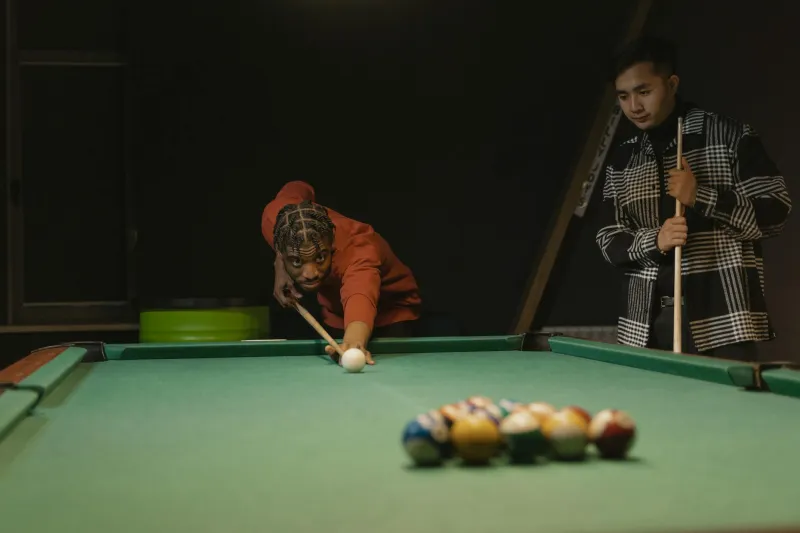
In 1965, if you wanted to find the real pulse of an American town, you didn't check the country club or the fancy restaurant. You walked into the pool hall at 7 PM on a Tuesday night and listened to the sound of democracy in action: the crack of balls, the scrape of chalk, and the voices of men from every corner of the community arguing about everything except their day jobs.
The pool hall was America's great equalizer. Your bank account didn't matter when you were lining up a shot. Your college degree couldn't help you sink the eight ball. In a world increasingly divided by class and education, the pool hall remained stubbornly meritocratic: you were only as good as your last game.
Where Quarters Built Community
For the price of a game – maybe fifty cents in 1970 – you could buy yourself an entire evening of entertainment and human connection. Not entertainment in the passive sense of watching a screen, but the active engagement of competition, conversation, and genuine social interaction.
These weren't gambling dens or rough joints, despite what Hollywood might have you believe. Most pool halls were surprisingly democratic spaces where factory workers, shop clerks, young men, and retirees shared tables and stories. The banker's son might play against the mechanic's apprentice, and the only thing that mattered was who could make their shots.
Compare that to today's entertainment landscape, where a night out easily costs $50-100 per person, and most "social" activities involve staring at individual screens. We've traded affordable community spaces for expensive isolation chambers.
The Art of Killing Time Productively
The pool hall taught something modern America has forgotten: how to spend unstructured time in the company of other people. There was no agenda, no schedule, no optimization. You showed up when you wanted, played as long as you felt like it, and left when you were ready.
This wasn't wasted time – it was essential time. Time to decompress from work without the pressure of formal social obligations. Time to sharpen a skill that had nothing to do with making money. Time to engage in the lost art of casual conversation with people you might not otherwise spend time with.
Young men learned from older players. Shy kids found their confidence. Recent immigrants practiced their English while learning the unspoken rules of American social interaction. The pool hall was an informal university where the curriculum was human connection.
The Geography of Gathering
Every American town once had at least one pool hall, usually downtown, usually accessible to anyone who could afford the price of a game. They were woven into the fabric of community life as essential infrastructure – not luxury amenities, but basic social utilities.
These spaces were designed for lingering. Comfortable chairs for spectators. Coffee that stayed warm all evening. Enough tables that you rarely had to wait long for a game. The economics worked because the overhead was low and the volume was steady: working-class people with a few dollars and a few hours to spend.
Today's entertainment venues follow a different model: maximum revenue per square foot, rapid customer turnover, premium pricing. The result is that affordable social spaces have largely vanished, replaced by expensive experiences that most working people can't afford on a regular basis.
Skills That Mattered
Pool taught things that couldn't be learned anywhere else: patience, precision, the ability to read angles and calculate probabilities in your head. More importantly, it taught social skills that no app can replicate: how to win gracefully, how to lose with dignity, how to trash talk without crossing lines, how to be competitive without being cruel.
These weren't trivial skills. In a world before social media and text messaging, knowing how to interact with strangers in low-stakes situations was essential preparation for navigating life. The pool hall was where young Americans learned to be comfortable in their own skin around people they didn't know well.
The Death of the Third Place
Sociologists talk about "third places" – spaces that aren't home and aren't work, where people can simply exist in community with others. The pool hall was perhaps America's most democratic third place: cheap, accessible, and genuinely welcoming to anyone who could hold a cue stick.
What replaced it? Chain restaurants with individual booths. Sports bars with massive screens that discourage conversation. Expensive hobby clubs that require significant financial commitment. Gaming centers that promote individual competition rather than social interaction.
We've created a landscape where working-class adults have fewer and fewer places to simply be together without spending significant money or committing to formal activities.
What We Lost When the Lights Went Out
The decline of the pool hall represents more than just changing entertainment preferences. It signals the broader erosion of informal social institutions that once helped American communities function.
We lost places where different generations mixed naturally. We lost spaces where skill and character mattered more than income and credentials. We lost the art of competitive play that brought people together rather than driving them apart.
Most importantly, we lost the understanding that democracy requires practice – not just in voting booths, but in the daily interactions where people from different backgrounds learn to respect each other's abilities and enjoy each other's company.
The pool hall's green felt tables are gathering dust in storage somewhere, but the hunger they satisfied – for affordable community, genuine competition, and authentic human connection – remains as strong as ever. We just haven't figured out where to satisfy it.