When the Best Family Vacations Started With a Gas Station Map and Zero Reservations
Photo: per "Source". Please credit "Family photos of Infrogmation"., CC BY-SA 4.0, via Wikimedia Commons
The night before the trip, your dad spread a road atlas across the kitchen table and traced a rough line with his finger. That was the plan. That was the entire plan. Somewhere around ten the next morning, the station wagon was loaded, the dog was dropped at a neighbor's house, and the family pulled out of the driveway pointed vaguely toward something that sounded fun.
Nobody had booked anything. Nobody had read a single review. The only real question was whether there'd be a decent motel before the kids hit critical mass somewhere around mile 300.
That was the American family road trip. And it produced some of the most vivid memories in the country's cultural inventory.
The Art of the Unscheduled Departure
Road trip planning in the pre-internet era operated on a beautifully loose framework. You had a destination in mind — or maybe just a region. You had a AAA TripTik if you were the organized type, a spiral-bound strip map that highlighted your route in orange and flagged gas stations along the way. If you weren't a AAA member, you had whatever map was folded incorrectly in the glove compartment.
Beyond that, the trip unfolded in real time.
You stopped at a roadside diner because the sign looked interesting. You pulled off at a state park because someone spotted a waterfall from the highway. You changed your route entirely because a gas station attendant mentioned there was something worth seeing twenty miles east. Detours weren't failures of planning. They were the whole point.
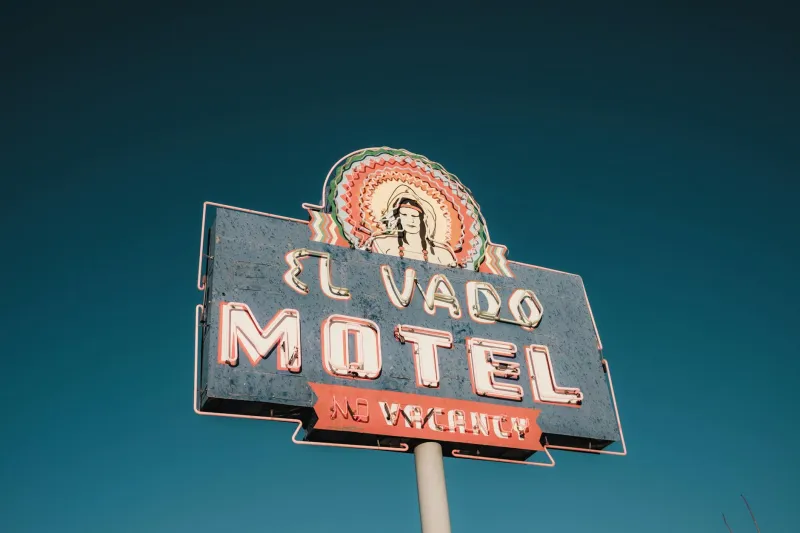
The motels you stayed in were chosen by a sign visible from the road and the presence of a pool. You pulled in, asked if they had a room, and either stayed or kept driving. The room might be perfect. It might be a little rough around the edges. Either way, it became part of the story.
What Planning Has Become
Book a family vacation today and the process looks almost nothing like that.
The average American family now begins researching a summer trip somewhere between three and six months in advance. Hotel rates fluctuate on dynamic pricing algorithms that can shift the cost of the same room by hundreds of dollars based on demand, timing, and factors that no human can fully predict or control. Booking too early means missing a price drop. Booking too late means paying peak rates or finding nothing available at all.
Restaurant reservations at popular destinations now require advance planning that would have seemed absurd twenty years ago. Some spots in national park gateway towns book out weeks ahead. Campsite reservations at major parks open months in advance and disappear within hours. Even the spontaneous-sounding activities — the kayak tour, the wine tasting, the guided hike — now have waitlists.
And then there are the reviews. The average traveler reads somewhere around six to twelve reviews before booking accommodation. Multiply that across hotels, restaurants, attractions, and car rentals and you're looking at dozens of hours of pre-trip research — often generating enough conflicting information to induce a kind of decision paralysis that the old gas station map never could.
Itinerary apps now exist specifically to schedule every hour of a vacation. Some families arrive at their destination with color-coded day plans that account for drive times between attractions, restaurant reservation windows, and optimal arrival times at popular spots to avoid crowds. The trip is optimized before it begins.
The Unexpected Moment Problem
Here's the thing about optimization: it's very good at eliminating the unexpected. And the unexpected is where most of the memorable stuff lives.
Ask someone in their forties or fifties about the family vacation they remember most vividly. Chances are it involves something that went sideways. The wrong turn that led to a roadside attraction nobody had planned for. The rainstorm that trapped everyone in a tiny diner for three hours and turned into an afternoon of card games and bad pie. The motel with the strange owner who told stories until midnight. The spontaneous decision to skip the scheduled destination entirely and spend an extra day somewhere none of you had heard of before you arrived.
None of those moments survive a tightly scheduled itinerary. They require slack — unplanned time, open roads, decisions made at the last second based on nothing more than a hunch or a hand-lettered billboard.
When every hour is accounted for, there's no room for the trip to surprise you. And the trips that can't surprise you are the ones you forget.
The Optimization Trap
It's worth asking why we plan so intensively now, because the answer isn't simply that we have the tools to do it.
Part of it is cost. Vacations have gotten genuinely expensive, and when you're spending real money, the instinct to protect the investment through planning makes sense. Nobody wants to drive four hours to a hotel that turns out to be a disaster when the reviews could have warned them.
But there's also a broader cultural shift toward optimization as a default mode. We track our sleep, our steps, our calories, our screen time. We optimize our commutes with real-time traffic data. We let algorithms curate our entertainment, our shopping, our social feeds. Applying that same optimization mindset to vacation feels natural — it's just how we operate now.
The cost is hard to measure because it shows up not as a failure but as an absence. The vacation was fine. The hotel was exactly as described. The restaurants were good. The attractions were interesting. Everything went according to plan.
And somehow, five years later, you can barely remember any of it.
The Case for Leaving Some Things Unbooked
None of this means modern travel is worse across the board. Knowing in advance that a hotel is clean, safe, and worth the price is genuinely useful information. Not having to sleep in a genuinely terrible roadside room because it was the only thing available is a reasonable improvement.
But there's a version of travel planning that's worth recovering — one that leaves deliberate gaps. A rough destination instead of a fixed one. One or two anchors instead of a fully mapped itinerary. A willingness to pull off the highway when something looks interesting, even if it costs you forty-five minutes.
The open road is still out there. It still has surprises in it. You just have to leave enough room in the schedule to let them happen.