Detasseling Corn at Dawn: The Summer Job That Turned Teenagers Into Something Else
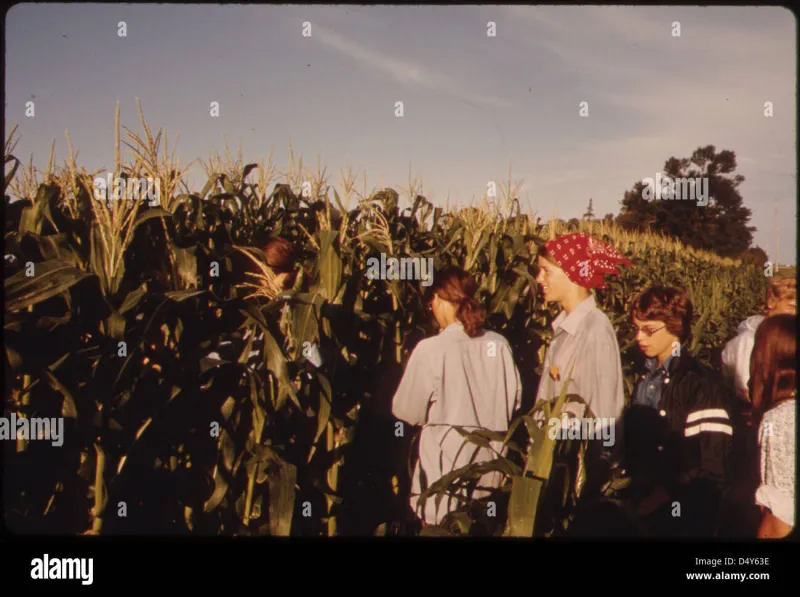
Photo: teenagers working corn field summer farm labor midwest, via c8.alamy.com
The alarm went off at 4:45 in the morning. You were fifteen. The air outside was already thick with humidity, and by the time the truck reached the first field the sky had turned from black to the kind of gray-pink that only exists in the Midwest in July. You climbed down, got your row assignment, and started walking.
Detasseling corn — pulling the pollen-producing tops off hybrid seed corn plants to control cross-pollination — is not glamorous work. It's repetitive, physically demanding, and conducted in conditions that range from uncomfortably warm to genuinely brutal. The corn leaves cut your arms. Your boots fill with mud after rain. The rows feel endless. By noon you've sweated through everything you're wearing and the afternoon hasn't started yet.
And for hundreds of thousands of teenagers across the Corn Belt and beyond, it was one of the most formative experiences of their entire lives.
 Photo: Corn Belt, via pub.mdpi-res.com
The Geography of the Summer Farm Job
The farm summer job wasn't one thing. It took different shapes depending on where you grew up in America.
In Indiana, Illinois, Iowa, and Minnesota, detasseling was a rite of passage so common it had its own folklore. Seed companies hired crews of teenagers every July, bused them to fields at dawn, and paid wages that felt significant to a kid who'd never earned more than babysitting money. The work lasted two to four weeks, intense and concentrated, and left you with a paycheck that could fund the rest of the summer.
In California's Central Valley and across the Pacific Northwest, fruit picking defined the season for teenagers near agricultural communities. Strawberries, peaches, apples, cherries — crops that needed hands and couldn't wait. The pay was often by the flat or the bushel, which meant your earnings were directly tied to how hard and how fast you worked. The lesson was immediate and unrepeatable.
 Photo: California's Central Valley, via www.geocurrents.info
In the South and the Great Plains, tobacco farms, cotton operations, and hay operations absorbed teenage labor through summers that stretched from late June through August. Baling hay is its own category of physical education — the weight of a bale, the rhythm of the work, the understanding that the job doesn't stop because you're tired.
 Photo: Great Plains, via cdn.savemyexams.com
Across all of these, the experience shared a common structure: early mornings, physical labor, adult expectations, and wages earned by output rather than presence.
What the Work Actually Taught
The obvious lesson was about money. You worked, you got paid, the connection was direct and legible. For many teenagers, the farm summer job was their first real encounter with the economics of their own time. Eight hours of detasseling corn produced a specific number of dollars. That number could be traded for specific things. The abstraction of adult financial life became concrete in a way that no classroom exercise could replicate.
But the deeper education was harder to name and more durable.
You learned what your body could do over a long day. You learned that discomfort was survivable and that the second hour of hard work felt different from the first. You learned to work alongside people you hadn't chosen — other teenagers from different schools, different towns, different backgrounds — toward a shared goal that had nothing to do with social dynamics or status. The corn didn't care who you were at school.
You also learned something about food. Standing in a field that produced the seed corn that would eventually produce the corn that fed livestock that eventually became dinner had a clarifying effect on the relationship between labor and eating. The food chain wasn't abstract. You were inside it, covered in pollen, earning your place in it for six dollars an hour.
The Slow Disappearance
The shift didn't happen overnight. Farm labor automation has been advancing for decades, and some of the work teenagers once did has simply been mechanized out of existence. Detasseling operations that once employed hundreds of local teenagers increasingly use mechanical detasselers for the majority of rows, with human crews handling only the passes the machines miss. The jobs still exist but in smaller numbers.
The cultural shift ran parallel to the economic one. As college admission became more competitive through the 1990s and 2000s, the summer calculus for middle-class families changed. A summer detasseling corn looked less valuable on a transcript than a summer interning at a nonprofit or attending a leadership program. The resume logic pushed teenagers toward experiences that signaled intellectual ambition rather than physical work.
By the 2010s, the internship had become the default aspirational summer experience for a significant portion of American teenagers. Many of these internships are genuinely educational. Many are also unpaid or minimally compensated, accessible primarily to families who can afford to support a teenager through an unpaid summer in a city. The democratizing quality of the farm job — available to any teenager willing to show up and work — doesn't transfer to the internship model.
The screen-based side hustle has emerged as another alternative: social media content creation, online tutoring, digital freelancing. These have real value and real flexibility. They also produce a very different kind of knowledge about work, one that's almost entirely disconnected from physical effort, weather, and the basic experience of being tired in your body at the end of a productive day.
The Gap Between Young Americans and Their Food
There's a specific consequence of the farm summer job's disappearance that doesn't get discussed much: the growing distance between young Americans and the agricultural systems that feed them.
This isn't a moralistic point about getting your hands dirty. It's a practical observation about knowledge. A generation that has spent time in fields, even briefly, carries a different understanding of what food production actually involves — the scale of it, the labor intensity, the dependence on weather, the margin for error. That understanding shapes how you think about food prices, agricultural policy, and the people who grow what you eat.
When that firsthand experience disappears from a generation's collective memory, the food system becomes something that happens somewhere else, managed by someone else, arriving at the grocery store through processes too distant to imagine clearly.
What the Sweat Was Worth
Ask anyone who detasseled corn or picked strawberries or baled hay as a teenager and the memories are almost universally vivid. The smell of the fields. The specific exhaustion of the work. The pride of a paycheck earned with your body. The friendships formed in conditions that stripped away most of the social performance teenagers usually maintain.
The work was hard and sometimes miserable and occasionally genuinely dangerous. Nobody is arguing for a return to child labor or romanticizing economic conditions that forced families to send their kids into fields out of necessity rather than choice.
But something real was produced in those fields beyond the corn and the fruit and the hay. A kind of knowledge about effort, about the physical world, about what your body is capable of when the row in front of you doesn't end. That knowledge is harder to find now, and the teenagers who grew up without it are navigating a world they understand a little less completely because of it.