Before the MRI, There Was Just a Doctor's Hands and a Gut Feeling
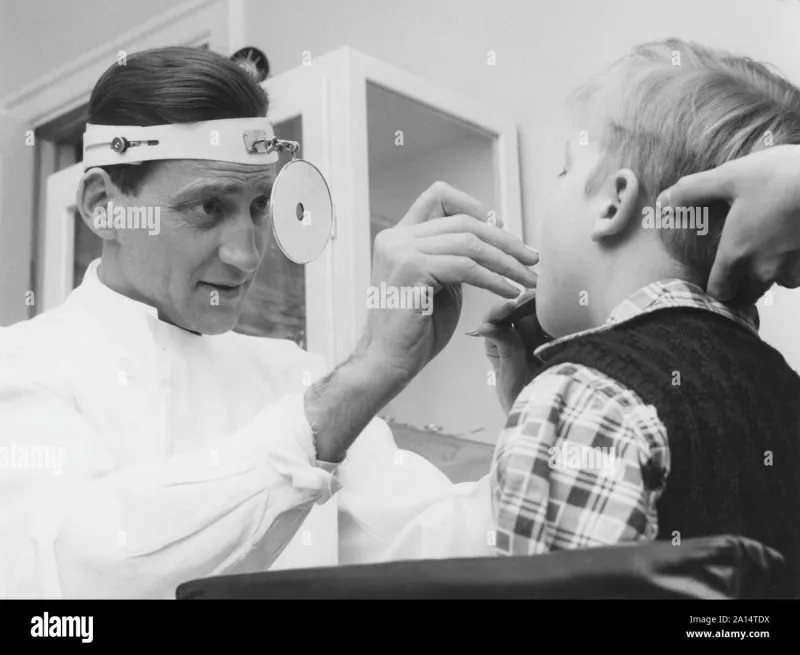
Photo: vintage doctor examining patient 1950s medical office, via c8.alamy.com
Before the MRI, There Was Just a Doctor's Hands and a Gut Feeling
Somewhere around 1958, a twelve-year-old in Ohio fell out of a tree and landed hard on his left wrist. His father drove him to the family doctor, who pressed two fingers along the bone, watched the boy's face, rotated the joint slowly, and said: probably a hairline fracture, maybe a bad sprain. He wrapped it in a splint, told the kid to rest it for six weeks, and sent them home with a bill that cost less than dinner at a diner.
That was the full medical experience. No X-ray. No follow-up imaging. No referral to an orthopedic specialist. Just a man who had been reading bodies for thirty years and trusted what his hands told him.
Today, that same fall would likely produce a same-day urgent care visit, a digital X-ray within fifteen minutes, possibly an MRI if anything looked ambiguous, and a follow-up with a sports medicine clinic inside a week. The diagnosis would be precise. The recovery plan would be individualized. And the bill would be staggering.
Both worlds have something important to teach us.
What Doctors Actually Did Before the Machines
X-ray technology existed well before the mid-twentieth century — Wilhelm Röntgen discovered it in 1895 — but access to imaging equipment was uneven across America for decades. Rural towns, small-city clinics, and general practitioners often worked without it. Even where machines existed, the instinct was to use them sparingly. Radiation concerns were real, equipment was expensive, and the culture of medicine leaned heavily on clinical judgment.
 Photo: Wilhelm Röntgen, via images.saymedia-content.com
Physicians relied on what was called palpation — the careful art of feeling a patient's body to locate swelling, tenderness, deformity, or abnormal movement. A good doctor could distinguish a clean break from a compound fracture, identify a dislocated shoulder from across the room, or detect a torn ligament by the specific way a patient's knee buckled under gentle pressure.
This wasn't guesswork in the careless sense. It was accumulated expertise, passed down through medical training and sharpened by thousands of patient encounters. Doctors who practiced in the same community for twenty or thirty years developed an intuitive library of human bodies under stress. They knew what a sprained ankle looked like on a man who worked in the fields versus a boy who played basketball. Context mattered. Experience was the instrument.
Six Weeks and a Lot of Stillness
What followed diagnosis was equally different from today. Recovery was largely passive. Rest, immobilization, time. A broken leg meant weeks in a cast, crutches, and a slow return to movement. A back injury meant bed rest — sometimes strict, sometimes for alarming stretches of time that modern medicine would consider counterproductive.
Physical therapy as a structured discipline existed, but it wasn't woven into everyday injury recovery the way it is now. You healed mostly at home, under the supervision of whoever lived with you. Neighbors brought food. Coworkers covered shifts. The community absorbed the disruption in ways that felt natural because they had to.
There was also a different relationship with pain. Americans of the mid-twentieth century generally expected injury to hurt, expected recovery to take time, and didn't treat either fact as a problem to be solved immediately. That's not a romanticized observation — it's simply a different cultural contract around the body and its limits. Endurance was considered part of healing.
The Revolution That Changed Everything
The shift began accelerating in the 1970s and exploded through the 1980s and 1990s. MRI technology became clinically widespread. Arthroscopic surgery — which allows surgeons to operate through tiny incisions using cameras and miniaturized tools — transformed orthopedic care. What once required major open surgery and months of recovery could now be done in an outpatient setting with a two-week return to light activity.
Sports medicine became its own specialty. Athletes who once retired after a serious knee injury now return to professional competition within months. ACL tears, once career-ending, are now almost routine repairs. Tommy John surgery has extended the careers of baseball pitchers by years. The human body, properly imaged and properly treated, turned out to be far more repairable than anyone in 1955 would have guessed.
For ordinary Americans, the gains are just as real. A fracture that heals incorrectly because it was misread by touch can cause lifelong pain. Early imaging catches things that fingers miss. Targeted physical therapy produces better outcomes than rest alone. The modern approach, for all its expense and complexity, genuinely works better in measurable ways.
What Got Quietly Lost
But something shifted in the transaction between patient and doctor that's harder to quantify.
When a physician diagnosed you by touch, they were fully present with your body. They had to be. The examination was intimate in the old sense of the word — close, attentive, personal. The doctor looked at your face while pressing on your ribs. They watched how you held your arm. They asked about your work, your habits, your history, because all of it was diagnostic information.
The machine doesn't need any of that. The MRI produces a perfect image regardless of whether the technician knows your name. The software reads the scan. The specialist reviews the file. Each step is more accurate and less human.
Patients today often report feeling processed rather than examined. Seen by equipment rather than by a person. The precision is real. The relationship is thinner.
There's also something worth noting about how we now relate to our own injuries. The expectation of imaging, of certainty, of a named and documented diagnosis, has changed how Americans experience physical pain. Uncertainty feels unacceptable in a way it didn't used to. If the scan comes back clean but you still hurt, the instinct is to scan again, to push for answers the technology hasn't produced yet. The old doctor would have said: give it time, come back in two weeks. That answer no longer satisfies.
A Different Kind of Healing
Neither era was perfect. People suffered from misdiagnosed fractures and missed internal injuries in the pre-imaging world. Real harm came from what those hands couldn't find. Nobody should pretend otherwise.
But it's worth pausing to notice what changed beyond the technology. The pace of healing. The role of community in recovery. The degree to which a doctor's accumulated human judgment was the primary tool in the room. These things drifted away quietly while the machines got better, and most of us didn't notice until they were gone.
The world heals faster now. It just heals with fewer people in the room.