The Card Catalog Kids: When Public Libraries Were America's Greatest Free Adventure
The Palace on Main Street
Every American town, no matter how small, had at least one building that promised unlimited adventure for the price of absolutely nothing: the public library. These weren't just repositories for books—they were democratic institutions where a kid with a library card held the same access to knowledge as the wealthiest resident in town.
Walk into any public library in 1985, and you'd immediately notice the hum of genuine activity. Kids sprawled across carpeted reading areas with picture books. Teenagers huddled around tables covered with research materials for school projects. Adults browsed newspapers from cities they'd never visited. The reference desk buzzed with questions that ranged from "How do you spell 'chrysanthemum'?" to "What's the population of Mongolia?"
The library wasn't just a place you visited when you needed something specific. It was a destination where curiosity could run wild, where following one interesting book could lead you down rabbit holes of discovery that lasted entire afternoons.
The Librarian as Navigator
Before search algorithms, there were librarians—human search engines who possessed an almost supernatural ability to connect curious minds with exactly the information they sought. These weren't just book clerks; they were knowledge professionals who understood that finding the right answer often required asking the right questions.
A typical reference librarian in the 1980s could guide a third-grader from "I want to know about dinosaurs" to a stack of age-appropriate books about paleontology, complete with recommendations for related topics like geology and evolution. They knew which encyclopedia had the best maps, which periodicals covered current events most thoroughly, and which reference books would satisfy even the most obscure research needs.
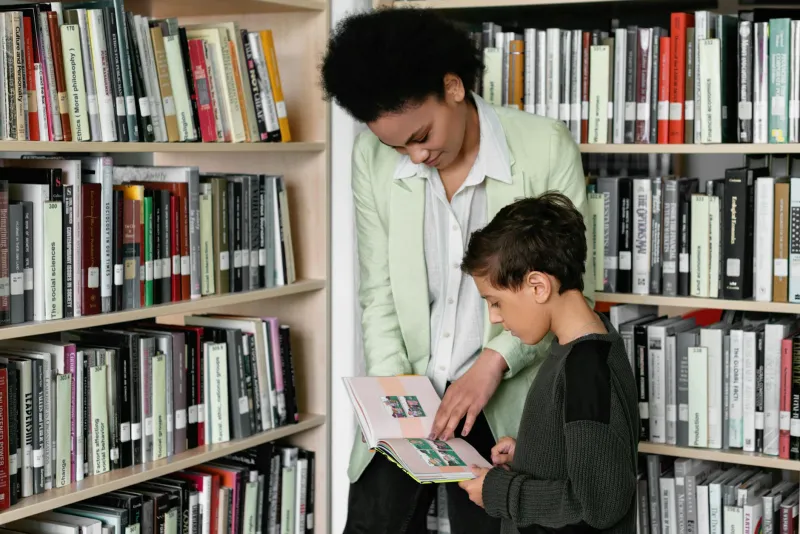
These librarians built relationships with their regular patrons, especially children. They remembered what kinds of books individual kids enjoyed, could suggest new authors based on previous reading habits, and took genuine pride in watching young readers graduate from picture books to chapter books to young adult novels.
The Card Catalog Treasure Hunt
Long before anyone conceived of clicking through hyperlinks, American children learned to navigate knowledge through the mysterious wooden cabinets that dominated every library's central area: card catalogs. These weren't just filing systems—they were treasure maps that taught kids how to think systematically about information.
Learning to use a card catalog required understanding alphabetical order, cross-referencing, and the Dewey Decimal System. But more importantly, it taught patience and the value of browsing. While searching for one specific book, you'd inevitably discover three others that looked interesting. The physical act of flipping through cards created serendipitous discoveries that no digital search could replicate.
Kids who mastered the card catalog developed research skills that served them throughout their academic careers. They learned that finding information required strategy, that knowledge was organized in logical systems, and that the most interesting discoveries often came from following unexpected connections between topics.
Summer Reading: The Season of Literary Olympics
For millions of American children, summer vacation didn't officially begin until they'd signed up for their library's summer reading program. These weren't just casual suggestions to read more books—they were community-wide celebrations of literacy that turned reading into a social activity.
Libraries competed to create the most engaging summer programs, complete with themes, prizes, and special events. Kids could earn stickers, certificates, and small prizes for reaching reading goals. More importantly, they could participate in book clubs, author visits, and themed activities that made reading feel like the coolest possible way to spend summer vacation.
The summer reading program created a culture where carrying a library book was a badge of honor, where kids compared reading lists the way they compared baseball card collections, and where finishing a particularly challenging book felt like a genuine accomplishment.
The Democratic Institution
Public libraries represented something uniquely American: the belief that access to information shouldn't depend on your family's income, your neighborhood's wealth, or your social status. A library card was perhaps the most democratic document a child could carry—it provided equal access to the same resources available to everyone else in the community.
This wasn't just theoretical equality. Libraries actively worked to ensure that every child could participate fully in their programs. They provided books in multiple languages, offered homework help for struggling students, and created safe spaces where kids could explore topics that interested them without judgment or restriction.
The children's section of most libraries was designed as a place where young minds could roam freely. Low shelves encouraged browsing. Comfortable reading areas invited extended stays. Bulletin boards displayed children's artwork and book recommendations. Everything about the space communicated that kids weren't just tolerated—they were the library's most important customers.
When Quiet Meant Productive
The traditional library atmosphere—hushed voices, the gentle sound of pages turning, the soft clicking of typewriters—created an environment that naturally encouraged deep focus and sustained concentration. This wasn't oppressive silence; it was productive quiet that helped visitors concentrate on reading, research, and learning.
Children learned to modulate their voices, to move thoughtfully through shared spaces, and to respect others' need for concentration. These weren't arbitrary rules—they were community standards that made it possible for everyone to use the library effectively.
The quiet atmosphere also created a sense of reverence for knowledge and learning. Libraries felt special precisely because they were different from the outside world. They were places where ideas mattered more than noise, where thinking was valued more than entertainment.
The Slow Death of America's Third Place
Today's public libraries face challenges that would have been unimaginable thirty years ago. Budget cuts have forced many libraries to reduce hours, eliminate programs, and lay off experienced librarians. The rise of internet research has reduced foot traffic, particularly among young people who've never learned to see libraries as anything more than book warehouses.
Many libraries have tried to adapt by becoming community centers that offer computer access, job training, and social services. While these programs serve important needs, they've fundamentally changed the library's role from a quiet place of learning to a busy hub of social activity.
The personal relationships that once existed between librarians and regular patrons have largely disappeared. Budget constraints mean fewer professional librarians and more part-time staff who don't have the time or training to provide the kind of individualized guidance that once made libraries magical for curious children.
What We Lost When We Stopped Looking Up
The decline of library culture represents more than just a shift in how we access information. It marks the end of a shared community institution that taught children to value learning for its own sake, to develop research skills through hands-on practice, and to see reading as a social activity worth celebrating.
The card catalog kids of the 1980s learned that finding answers required patience, strategy, and often the help of knowledgeable adults who cared about their intellectual development. They discovered that the most interesting questions often led to unexpected places, and that the journey of discovery could be as rewarding as the destination.
Today's children can access more information in five minutes than previous generations could gather in five hours. But they've lost something that can't be measured in search results: the experience of being personally guided through the world of knowledge by adults who made learning feel like the greatest adventure of all.