When a Burger, Fries, and Coffee Cost Less Than a Movie Ticket: The Death of America's Working Class Dining Room
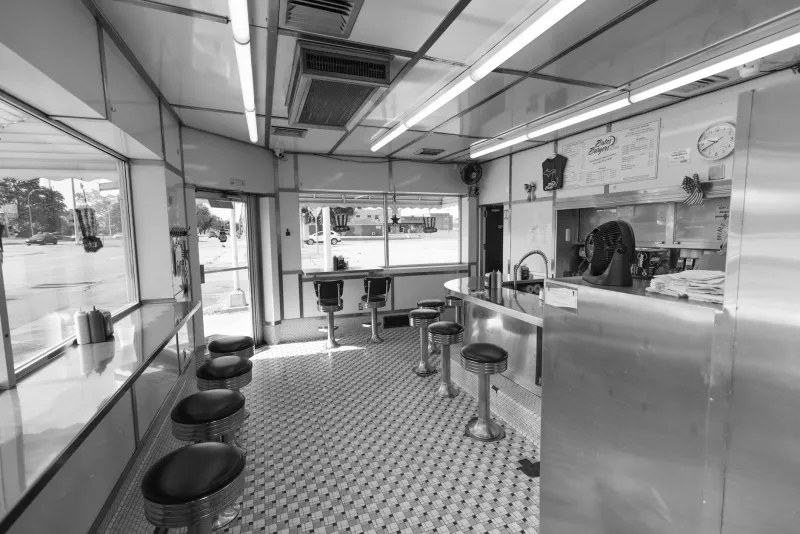
The Counter Where Everyone Was Equal
Walk into any American town in 1955, and you'd find it: the lunch counter that served as the neighborhood's unofficial town square. Chrome stools lined up in front of a grill where you could watch your burger sizzle, while a waitress in a starched uniform called you "hon" and knew whether you wanted your coffee black or with cream.
A complete meal—say, a cheeseburger, fries, and coffee—would set you back about 85 cents. That's roughly $9.50 in today's money. But step into a casual dining restaurant today, and that same meal easily costs $25 before tip. The math alone is staggering, but the real story isn't just about inflation run wild.
Where Working America Used to Eat
These weren't just restaurants; they were institutions. Every neighborhood had one, usually owned by a Greek immigrant family or a couple who'd saved up enough to buy their own piece of the American dream. The menu was simple: meat and potatoes, honest food cooked fresh throughout the day.
The clientele was everyone. Construction workers grabbing lunch sat elbow-to-elbow with office managers, retirees, and traveling salesmen. Nobody dressed up, nobody made reservations, and nobody felt out of place. The great equalizer wasn't just the affordable prices—it was the shared experience of sitting at a counter, making small talk with strangers, and being part of your community's daily rhythm.
Consider this: in 1960, the average American family spent about 17% of their income on food, with a significant portion of that going to these neighborhood establishments. Working folks could afford to eat out regularly, not as a special occasion but as part of normal life.
The Economics of Eating Out
What happened? The answer lies in a perfect storm of economic changes that transformed American dining forever.
First, labor costs exploded. In 1955, minimum wage was 75 cents an hour, and restaurant workers often made decent money through tips on affordable meals. Today's minimum wage varies by state, but even at $15 an hour, it hasn't kept pace with the cost of running a restaurant. Insurance, rent, utilities, and food costs have all outpaced wage growth by enormous margins.
Then came the corporatization of dining. Independent diners couldn't compete with chain restaurants that could buy ingredients in bulk and streamline operations. But even fast food, originally positioned as the budget alternative, has priced itself into luxury territory. A family meal at McDonald's now costs what a sit-down dinner used to.
The Tipping Point That Changed Everything
Perhaps nothing illustrates the shift better than America's relationship with tipping. In the 1950s, a 10% tip was standard and generous. The bill was low enough that tipping felt natural, not burdensome. Today, with tablet screens suggesting 22% tips on already inflated prices, dining out has become a mathematical anxiety exercise.
The old lunch counter didn't just serve food—it served as a social safety net. If you were short on cash, the owner might let you work it off washing dishes. If you were new in town, the counter was where you learned about job openings and available apartments. These relationships can't exist when every transaction is processed through a POS system and every interaction is calculated for maximum efficiency.
Fast Food Filled the Gap, But Not Really
As traditional diners disappeared, fast food chains promised to fill the void with speed and affordability. For a while, they delivered. But even fast food has abandoned its original promise. A basic meal at McDonald's that cost $2 in 1990 now costs $12 or more in many markets.
The quality trade-off became acceptable when the price was right. But now that fast food costs nearly as much as casual dining used to, we're paying premium prices for food that's designed to be cheap, fast, and forgettable.
What We Lost Along the Way
The disappearance of the affordable neighborhood diner represents more than just economic change—it's cultural erosion. We lost the daily ritual that brought different social classes together in the same space. We lost the knowledge that came from regular interaction with the same people. We lost the comfort of being known somewhere.
Today's dining landscape is bifurcated: either expensive sit-down restaurants for special occasions, or fast food consumed in isolation. The middle ground—the place where working people could afford to be social—has largely vanished.
Young Americans today have never experienced the casual luxury of being able to walk into any neighborhood joint and order a hot, fresh meal for pocket change. They've never sat at a counter where the person next to them might become a friend, or where the waitress remembered how they liked their eggs.
The New Reality
In a world where a simple lunch for two routinely costs $40 or more, eating out has become either a calculated splurge or a surrender to convenience food. The spontaneous decision to grab a bite somewhere nice—the kind of decision that built community connections—is now a budget consideration for most American families.
We've gained efficiency, consistency, and convenience. But we've lost something harder to quantify: the everyday democracy of the lunch counter, where anyone could afford to belong.