The Dinner Table That Used to Hold Families Together: When Sunday Stopped Being Sacred
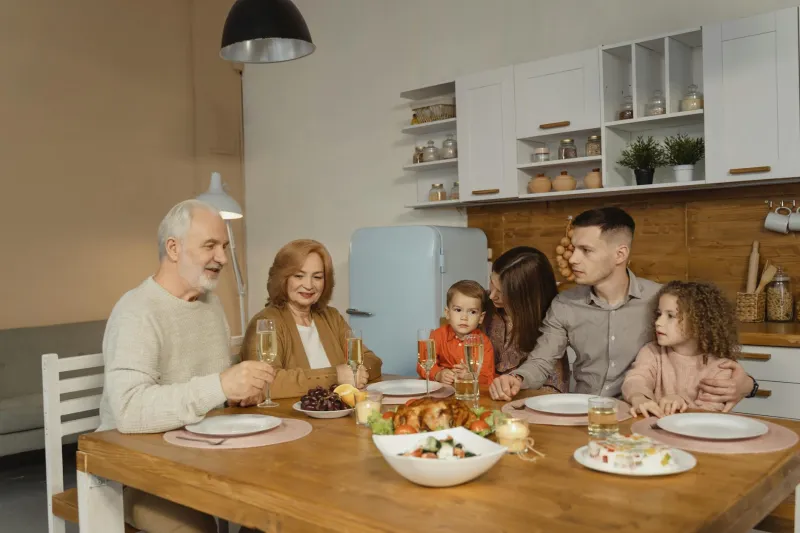
The Ritual That Structured an Entire Week
There was a time—not that long ago—when Sunday dinner wasn't something you scheduled. It was something you simply did.
It didn't require a calendar invite or a group text three days in advance. It didn't get cancelled because someone had a work email to answer or a kid's soccer tournament in the next county. It was as fixed a part of the week as Sunday morning itself, a gravitational force that pulled people out of their separate orbits and back toward the table.
For most of the 20th century, this meal was the anchor of American family life. Mom spent much of Sunday morning preparing it—a pot roast, a casserole, fresh rolls, a pie. The older kids might help. Dad would sit at the kitchen table, reading the newspaper and offering commentary. Grandparents, if they lived nearby, often came. Sometimes aunts and uncles dropped in. The meal itself might last an hour or more, with conversation drifting from gossip to politics to plans for the week ahead.
This wasn't a luxury reserved for the wealthy. Working-class families did it too. Poor families did it. It was simply how Americans organized their time and their relationships. The Sunday dinner was the weekly reset button—the moment when you checked in with each other, when you maintained the bonds that kept a family functional across the other six days of relative chaos.
The Slow Unraveling
Somewhere around the 1980s and 1990s, the tradition began to fray.
Part of it was economic. More mothers entered the workforce, not as a preference but out of necessity. Wages stagnated while the cost of living climbed. Two incomes became the baseline for a middle-class existence. That meant less time for Sunday meal preparation. It also meant that people worked on weekends—or at least, the expectation that they might work on weekends became normalized.
Part of it was logistical. As suburbs sprawled and families dispersed, grandparents no longer lived two blocks away. They lived four hours away. Extended family became something you saw a few times a year, not every Sunday. Meanwhile, kids' activities—sports leagues, music lessons, academic competitions—began extending into weekend hours. A child might have a soccer tournament on Saturday and another on Sunday. The family had to choose: attend the game or attend dinner. The game usually won.
Part of it was cultural. The rise of convenience foods meant that dinner no longer required an entire morning of preparation. You could grab a rotisserie chicken from the grocery store. You could order takeout. You could each eat whatever you wanted, whenever you felt like it. The meal transformed from a production that demanded coordination and planning into something you could accomplish in 20 minutes.
But the biggest shift was philosophical. Somewhere along the way, we stopped treating family time as non-negotiable. We started treating it as something you fit in if you could, once you'd taken care of everything else.
The Technology That Solved the Problem We Didn't Know We Had
The irony is that technology was supposed to make this easier. Cell phones meant you could coordinate dinner times instantly. Online recipe databases meant you didn't need to memorize your mother's casserole recipe. Grocery delivery services meant you didn't have to spend an hour shopping.
Instead, technology became the instrument of the dinner's slow extinction.
Now, instead of sitting together without distraction, family members sit together while half-present—phones on the table, checking messages, scrolling through social media, responding to work emails. The meal still happens, but the ritual has been hollowed out. You're physically present but mentally elsewhere.
Or the meal doesn't happen at all. Someone's in their room eating alone. Someone's at a practice. Someone's working. Everyone eats at different times, according to their own schedules and preferences. The family stops functioning as a unit and becomes a collection of individuals who happen to live in the same house.
What Disappeared When the Table Emptied
Social scientists have spent years studying the decline of family meals, and the data is consistent: kids who eat dinner with their families perform better in school, have stronger mental health, are less likely to develop eating disorders, and have lower rates of substance abuse. The mechanism isn't mysterious. It's the conversation. It's the attention. It's the message that says: You matter enough that I'm putting everything else down for an hour.
But it's not just about the kids. Family dinners were also how adults maintained their relationships. A marriage doesn't stay strong through grand gestures. It stays strong through small rituals—the coffee together in the morning, the conversation over dinner, the check-in at the end of the day. When those rituals collapse, the relationship becomes transactional. You're coordinating logistics, not maintaining intimacy.
The Sunday dinner was also how cultural knowledge and values got transmitted. Your grandmother told you why she always added vinegar to the pot roast. Your father explained what he did at work and why it mattered. You learned what your family believed about money, religion, politics, and how to treat people. You didn't learn it through formal instruction. You absorbed it through conversation and observation.
Now, that transmission happens (if at all) through texts and quick phone calls. It's fragmented and incomplete. Kids grow up without a clear sense of where they come from or what their family actually stands for.
The Attempts to Bring It Back
Some families have recognized the loss and tried to reclaim it. They designate one night a week as "family dinner night." They put phones away. They cook together. They talk.
But here's the painful truth: it doesn't feel the same. It feels like something you have to schedule. It requires effort. It's a conscious choice rather than an inevitable rhythm. And that changes the whole nature of it.
When Sunday dinner was simply what you did, it didn't require willpower or commitment. It was just the shape of your week. Now, maintaining it requires actively resisting the gravity of modern life—the work demands, the activity schedules, the digital distractions, the cultural message that staying busy is the same as being important.
The Real Cost of Convenience
We gained the ability to eat whenever we want, whatever we want, wherever we want. We gained flexibility. We gained convenience. We gained the option to prioritize individual preferences over collective rituals.
But we lost something that can't be easily measured in data but can be felt in the texture of family life: a regular, predictable moment when everyone paused and came together. A moment that said family was the priority, not the fallback. A moment that built bonds strong enough to withstand the inevitable conflicts and disappointments of real life.
Your great-grandmother spent Sunday morning preparing a meal that would be gone in an hour. By modern standards, it was wildly inefficient. But that inefficiency was the point. The time spent was the gift. The message communicated—through the effort, the attention, the gathering—was that this mattered.
Now we can order dinner to our door in 30 minutes and eat it while scrolling through our phones. We're more efficient. We're more flexible. We're also, in some way we're still figuring out, more alone.