The Guy Behind the Counter Who Knew Your House Better Than You Did
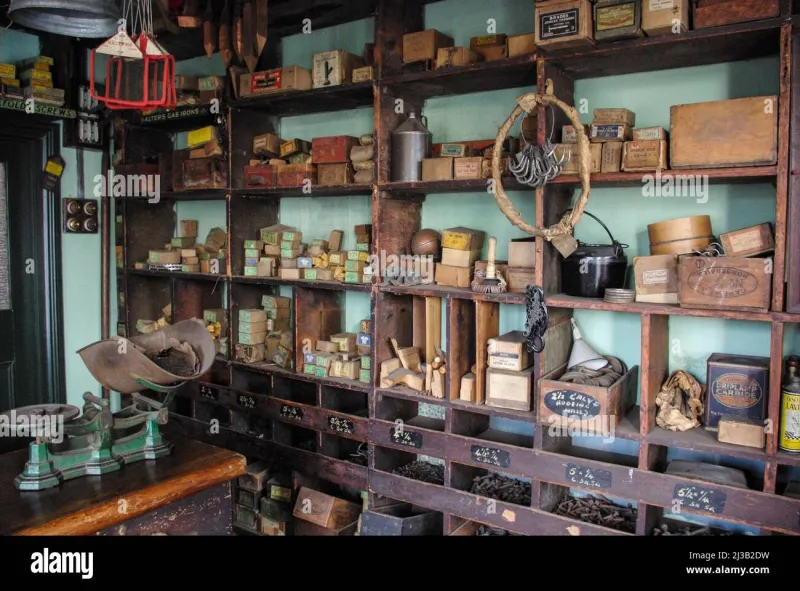
Photo: vintage neighborhood hardware store interior counter tools, via c8.alamy.com
There used to be a place in every American town where you could walk in with a broken thing and walk out knowing exactly how to fix it. It wasn't a warehouse with fluorescent lights stretching to the horizon. It was a narrow shop that smelled like linseed oil and sawdust, and the guy behind the counter had probably already helped your father fix the same problem twenty years ago.
That place was the neighborhood hardware store. And what it offered went far beyond nuts and bolts.
The Store That Knew Your Address
In the 1950s, '60s, and well into the '70s, most American towns had at least one independently owned hardware store. These weren't chains. They were family operations — often passed from parent to child — staffed by people who had spent decades learning the practical language of homes, pipes, wiring, wood, and weather.
The owner might know that the houses on Elm Street were all built with a particular type of cast iron fitting that required a specific wrench. He might remember that your dad had come in three summers ago with the same leaky faucet problem and walked out with a fifteen-cent washer and a five-minute tutorial. These stores weren't just retail operations. They were living archives of local construction history.
 Photo: Elm Street, via www.vintagemovieposters.co.uk
You didn't need to know what you needed. You just needed to describe the problem. "The pipe under my sink is dripping where it bends." That was enough. The man behind the counter would ask two follow-up questions, disappear into an aisle, return with a small paper bag, and spend the next ten minutes explaining exactly what to do with what was inside it. No upselling. No warranty pitch. Just information, freely given.
Practical Wisdom as a Public Good
What made these stores remarkable wasn't the inventory — it was the accumulated knowledge on the other side of the counter. These were people who had seen ten thousand household problems walk through their door. They knew which products actually worked and which ones were marketing dressed up as hardware. They knew when a job was genuinely DIY territory and when you needed to call a plumber before you made things worse.
For working-class homeowners especially, this was invaluable. Hiring a contractor for every small repair wasn't financially realistic. But with fifteen minutes of honest advice and a two-dollar part, a homeowner who had never touched a pipe wrench could tackle a job with real confidence. The hardware store was, in a very practical sense, a form of free education.
And it was social, too. People lingered. Conversations happened between customers. A retired electrician waiting to pay for sandpaper might overhear your problem and chime in with a better solution than the one you'd already been given. The store functioned as a community problem-solving hub in a way that no website forum has ever quite replicated.
The Big Box Takeover
The math of the 1980s and '90s was brutal for small hardware stores. Home Depot opened its first location in 1979. Lowe's expanded aggressively through the following decade. These new megastores could stock ten times the inventory at prices that independent shops simply couldn't match. One by one, the neighborhood places closed.
 Photo: Home Depot, via www.shutterstock.com
What replaced them was enormous and often overwhelming. The modern home improvement warehouse carries roughly 35,000 products across acres of floor space. That's genuinely impressive. But try finding someone on a Saturday afternoon who can tell you which of those 35,000 products actually solves your problem — and explain how to use it.
The staff at these stores aren't the issue. Many of them are knowledgeable and genuinely helpful when you can find them. But the model isn't built around advice. It's built around volume. The store doesn't need to know your house. It needs to move product. Those are very different missions.
Today, most homeowners facing an unfamiliar repair turn to YouTube, Reddit threads, or manufacturer FAQs. These are useful resources. But they're also generic. A video tutorial doesn't know that your house was built in 1948 with materials that haven't been standard since Eisenhower was president. The neighborhood hardware guy did.
What We Actually Lost
The closing of these stores wasn't just a commercial shift — it was a transfer of knowledge from human beings into search engines. The practical wisdom that once lived in the heads of hardware store owners is now scattered across the internet in fragments, some accurate, some dangerously wrong, none of it tailored to your specific situation.
There's also something worth naming about confidence. When a knowledgeable person looks you in the eye and says "you can do this, here's how," it carries a weight that a YouTube thumbnail simply doesn't. Generations of Americans learned to maintain their own homes partly because someone at the hardware store made them believe they could.
A handful of independent hardware stores survive. Ace Hardware's cooperative model has helped some local shops stay competitive. And in certain cities, a new generation of owners is trying to rebuild that advisory culture deliberately, leaning into expertise as the thing big boxes can't replicate.
 Photo: Ace Hardware, via dengarden.com
But for most Americans, the era of walking in with a problem and walking out with a solution — plus a ten-minute education — is over. What replaced it is bigger, cheaper, and infinitely less personal. Whether that's progress probably depends on how long you spent in the plumbing aisle last Saturday, staring at forty-seven nearly identical fittings, with no one nearby who could tell you which one you actually needed.