The Republic of Nowhere in Particular
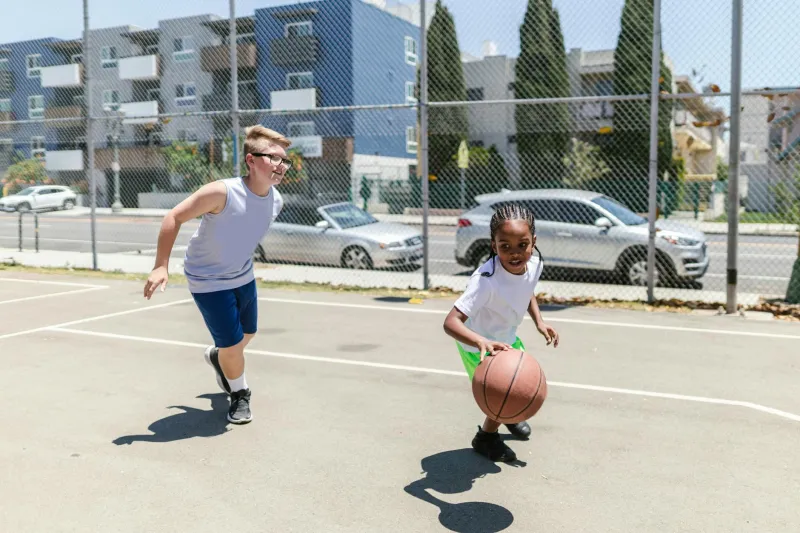
Every American neighborhood used to have them: those magical spaces that weren't quite parks, weren't quite playgrounds, but somehow became the most important places in a kid's world. A cracked basketball court behind the elementary school. A vacant lot where someone had worn a baseball diamond into the weeds. The dead-end street where goal posts were marked by parked cars and "out of bounds" was Mrs. Henderson's flower bed.
 Photo: Mrs. Henderson, via ambassadorarchives.weebly.com
These weren't official anything. No permits, no maintenance schedules, no liability insurance. They just existed in the gaps of adult planning, claimed by children who understood something their parents had forgotten: the best games happen when nobody's watching.
In these spaces, kids created something remarkable—a functioning democracy that would have impressed the founding fathers.
The Constitution Written in Chalk and Spit
Every pickup game began the same way: with negotiation. Who's playing? How long until dark? What are the rules today? These weren't predetermined answers—they required consensus building that would challenge most corporate boardrooms.
Four kids wanted to play basketball, but only three showed up with sneakers? The group had to decide: play with one person in street shoes, or modify the rules to accommodate the disadvantage. Seven kids for a football game when you really needed eight? Someone had to play quarterback for both teams, and everyone had to agree that was fair.
These weren't arbitrary decisions imposed by adults—they were social contracts negotiated by the people who had to live with the consequences.
The rules evolved organically. "No checking in street hockey because Tommy doesn't have pads." "Home runs only count if you can actually run the bases before the ball comes back." "If it hits the telephone wire, it's a do-over." Each rule represented a group decision about how to make the game work for everyone present.
 Photo: Tommy, via media.tommy.com
The Art of Self-Governance
Pickup games had no referees, no coaches, no parents hovering on sidelines with opinions about every call. Kids had to police themselves, and somehow, it mostly worked. Not because children are naturally fair—anyone who's ever been around kids knows better—but because they understood that fairness was the price of continuing to play.
When disputes arose, and they always did, resolution couldn't be appealed to a higher authority. You had to work it out among yourselves or the game ended. This created powerful incentives for compromise, negotiation, and creative problem-solving.
"That was out!" "No way, it hit the line!" "Let's just replay the point."
These weren't just arguments about sports—they were crash courses in conflict resolution, taught by necessity and reinforced by the desire to keep playing.
The Meritocracy That Actually Worked
Pickup games were ruthlessly egalitarian in ways that organized sports never managed. Your parents' income didn't matter. Whether you lived in the big house or the apartment complex was irrelevant. The only currency that counted was ability, effort, and whether other kids wanted you on their team.
This created natural leadership that had nothing to do with adult appointments. The kid who could organize teams fairly, keep arguments from exploding into fights, and make sure everyone got to play became the unofficial commissioner of the vacant lot. These weren't elected positions—they were earned through competence and respected through results.
Age hierarchies existed but were fluid. A skilled eight-year-old could earn respect from twelve-year-olds based purely on performance. An older kid who was a poor sport might find themselves excluded despite physical advantages.
The social dynamics were complex and constantly shifting, teaching lessons about leadership, followership, and the delicate balance between individual achievement and group cohesion.
When Scheduling Killed Spontaneity
Sometime in the 1990s, American childhood became a managed experience. Youth sports moved from vacant lots to official fields, from spontaneous gathering to scheduled practices, from self-governance to adult supervision. Parents, motivated by love and concern for their children's futures, began organizing childhood with the efficiency of Fortune 500 companies.
Travel teams replaced neighborhood games. Professional coaches substituted for peer leadership. Liability insurance eliminated the beautiful chaos of unsupervised play. The pickup game—with its imperfect fields, negotiated rules, and democratic decision-making—became an endangered species.
This wasn't necessarily wrong. Organized sports provide better coaching, safer equipment, and more opportunities for serious athletes to develop their skills. But something irreplaceable was lost in the translation from sandlot to soccer complex.
The Democracy Lessons Nobody Teaches Anymore
Pickup games taught civic skills that no classroom could replicate. How to build consensus among people with different interests. How to enforce rules when there's no external authority. How to balance individual achievement with group harmony. How to lead without formal power and follow without losing dignity.
These weren't theoretical lessons—they were practical skills developed through daily practice. Kids learned that democracy isn't about getting your way; it's about finding ways for everyone to get enough of what they want to keep participating.
They discovered that leadership isn't about authority—it's about service. The best "commissioners" of pickup games weren't the most talented players; they were the kids who could make the game work for everyone.
The Skills We're Not Teaching
Today's organized youth sports teach valuable lessons: discipline, teamwork, respect for authority, the importance of practice. But they can't replicate the democratic skills that pickup games developed naturally.
When adults make all the rules, schedule all the games, and resolve all the disputes, children never learn to do these things for themselves. They become excellent at following instructions and respecting authority, but they miss out on the harder lessons of creating authority, building consensus, and managing conflict without external intervention.
Modern kids are incredibly skilled at navigating adult-designed systems. But they've had fewer opportunities to design systems themselves, to experience the messy, imperfect, essential work of democratic self-governance.
The Vacant Lot as Laboratory
Those disappeared spaces weren't just places to play—they were laboratories where American democracy renewed itself every generation. Kids who learned to negotiate fair teams in vacant lots grew up to be adults who could build consensus in boardrooms, town halls, and community organizations.
The pickup game was where America taught its children that authority isn't something you're born with—it's something you earn. That fairness isn't a rule imposed from above—it's an agreement negotiated among equals. That leadership isn't about power—it's about service.
We've professionalized childhood sports and gained efficiency, safety, and skill development. But we've lost something harder to measure and impossible to replace: the place where kids learned that democracy isn't something adults do—it's something everyone must practice, starting with the simple question of who gets to play and how the game should work.
Somewhere in America, there's probably still a vacant lot where kids gather after school to play ball. If you find it, stop and watch. You're seeing something precious: democracy in its purest form, practiced by people too young to know how rare and valuable it's become.