When Flying Felt Like an Occasion: The Long Descent From Elegant Escape to Cattle Car in the Sky
The Golden Age Nobody Talks About Anymore
There's a photograph somewhere in your family's archives—maybe tucked in a shoebox, maybe in a photo album your mother hasn't looked at in years. In it, your father (or grandfather) is standing in front of a jet in slacks and a blazer, maybe a tie. He's probably smiling. He's dressed up because flying is an event. It's something worth commemorating with a photograph.
This wasn't unusual. In the 1950s and 1960s, flying was glamorous. It was expensive. It was something you did for special occasions—a business trip that was significant enough to warrant the cost, a once-in-a-lifetime vacation, a family reunion important enough to justify the expense. You dressed up for it the way you'd dress up for church or a nice dinner. The airline industry encouraged this. Stewardesses (as they were called) were recruited for their appearance as much as their service skills. They wore uniforms that looked like fashion statements. The entire experience was designed to make you feel special.
The meals served on flights were prepared in airline kitchens and heated on board. You got real plates, real silverware, real glasses. On long flights, you got multiple courses. The portions were generous. The service was attentive. The experience of flying—the thing itself—was part of the vacation, not a hurdle to get through.
The seats were spacious. A typical seat pitch (the distance from one seat to the next) was around 35 inches. You could recline without your knees hitting the seat in front of you. You could move. You could stretch. You could actually sit in your seat rather than merely occupying the space.
Flying wasn't comfortable exactly—it was an airplane, after all—but it was dignified. It was an experience designed around the passenger's wellbeing, not maximum revenue extraction.
The Deregulation That Changed Everything
In 1978, the airline industry was deregulated. This was supposed to be good news. Deregulation would introduce competition. Competition would drive down prices. Lower prices would make flying accessible to regular people instead of just the wealthy.
It worked. Sort of. Prices did drop. Flying became affordable for the middle class. But the mechanism by which airlines achieved those lower prices fundamentally restructured the entire industry.
Before deregulation, airlines were required to maintain certain service standards. There were rules about minimum seat sizes, about what you had to serve, about how many flights you had to operate. It was a regulated utility, like electricity or phone service. It wasn't profitable in the way modern businesses are profitable, but it was stable and it provided a consistent service.
Deregulation removed those rules. Suddenly, airlines could compete on price alone. And the only way to compete on price while maintaining profitability was to reduce costs. A lot.
The first cost reduction was obvious: cut the frills. The hot meals became cold sandwiches, then snack boxes, then you had to pay for snacks. The real plates became plastic trays. The silverware became plastic utensils. The multiple courses became a single, mediocre offering.
But cutting catering costs only goes so far. The real money was in seat density. If you could fit more seats on a plane, you could spread the fixed costs (fuel, crew, landing fees) across more passengers, which meant lower per-passenger costs and higher profit margins.
So airlines began shrinking the space between seats. They reduced the recline function. They narrowed the seats themselves. They removed amenities like pillows and blankets (which you now have to pay for on many carriers). They introduced basic economy fares that don't include carry-on luggage or seat selection.
The Nickel-and-Diming That Became the Business Model
By the 1990s and 2000s, airlines had figured out something important: they could charge separately for things that used to be included. Checked baggage? That's $25 now. Extra legroom? That's $50. Seat selection? $15. A beverage that isn't water? That's $7. Boarding priority? That depends on which tier of the loyalty program you're in.
This is called "unbundling." The airline breaks down the service into individual components and charges separately for each one. The stated logic is that it allows people to pay only for what they use. If you're a light packer, you don't pay for checked baggage. If you don't care about seat selection, you don't pay for it.
But the real effect is that the advertised price becomes almost meaningless. An airline can advertise a $99 flight, but by the time you add in checked baggage ($35), seat selection ($15), and a carry-on bag (which basic economy doesn't include, so that's another $40 if you want it), you're paying $189. The price wasn't actually $99. It was $189, but $90 of it was hidden until you got to the final checkout screen.
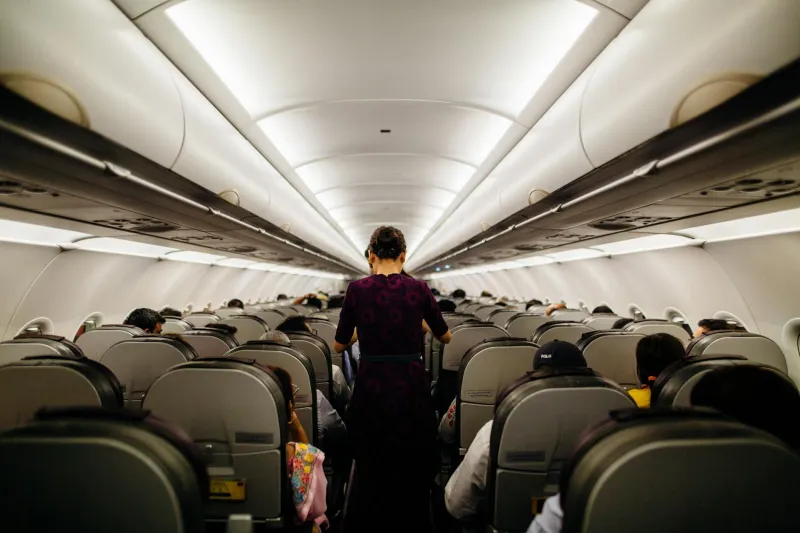
Meanwhile, the space between seats has compressed to the point where it's genuinely uncomfortable for most adults. The average seat pitch is now 31 inches—four inches less than in the golden age. For tall people, or people with long legs, or people with mobility issues, it's genuinely painful.
The Psychological Shift Nobody Planned
What's interesting is that flying hasn't actually become cheaper, when you account for all the fees. Studies have shown that the total cost per passenger is roughly comparable to what it was in the 1970s, adjusted for inflation. But it feels cheaper because the price is obscured. And the experience feels worse because the service is visibly degraded.
You used to pay more upfront and get a better experience. Now you pay less upfront and get squeezed into a seat that was designed for someone three inches shorter than the average American, served food that tastes like it was processed in a factory (because it was), and nickel-and-dimed at every step.
The psychological effect is significant. Flying used to be something to look forward to. Now it's something to dread. You're not excited about the journey. You're anxious about whether your flight will be delayed, whether your luggage will be lost, whether you'll be able to find an overhead bin for your carry-on, whether you'll be stuck next to someone who can't respect the armrest boundary, whether the person in front of you will recline their seat into your lap.
The airline has succeeded in reducing costs and maintaining profitability. But they've done it by making the experience worse—not worse in the sense of being less fancy (that was inevitable), but worse in the sense of being less pleasant, less dignified, less humane.
What We Lost, and Why It Matters
It's easy to dismiss this as just another example of how capitalism optimizes for profit at the expense of human experience. And there's truth to that. But there's something deeper worth considering.
Flying used to be an experience that reinforced a certain vision of American life. You dressed up. You were treated well. You were offered food and service. The message was: You deserve this. This is worth your time and money.
Now, flying is an experience that reinforces a different vision. You're packed in. You're charged for basic services. You're made to feel like you're getting away with something if you manage to board without paying extra fees. The message is: You're lucky we let you fly at all. Don't expect us to be nice about it.
One vision treats travel as something aspirational, something that enriches your life. The other treats it as a commodity to be exploited. The shift from one to the other wasn't inevitable. It was a choice—made by airlines, enabled by deregulation, and accepted by passengers who had no alternative.
Your father dressed in a suit to fly because flying felt important. Now you wear jeans and a t-shirt because flying feels like taking the bus—except the bus is 35,000 feet in the air, you can't move, and you paid $189 for the privilege of being squeezed in like cargo.
We didn't gain efficiency. We gained the illusion of lower prices while sacrificing dignity, comfort, and the sense that travel is something worth savoring. And somewhere along the way, we stopped questioning whether that was actually a good trade.