Listen to That Engine Sing: The Lost Art of Fixing Cars by Ear
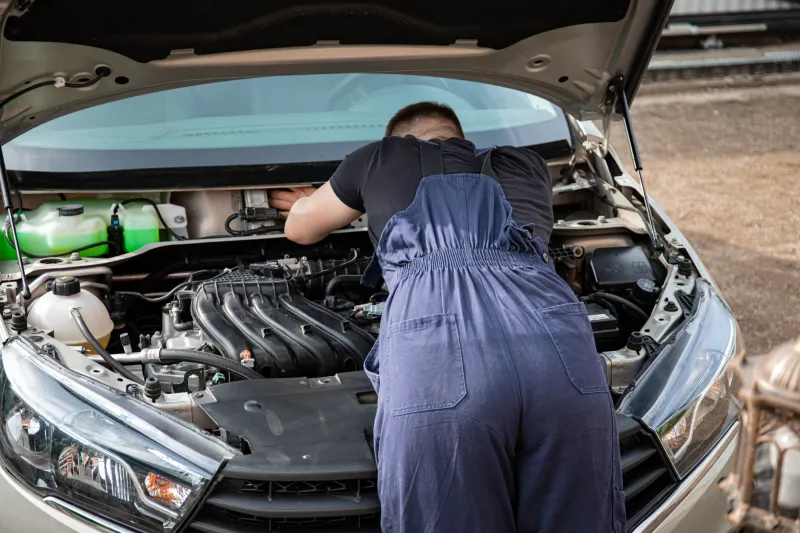
Pull into any dealership service bay today and watch what happens. A technician plugs a cable into a port beneath your dashboard, a laptop screen flickers to life, and within sixty seconds the computer tells them exactly what's wrong. Error code P0420. Catalytic converter efficiency below threshold. It's precise, it's fast, and it leaves almost nothing to interpretation.
Now rewind to 1971. You pull a rattling Buick Skylark into a gravel lot outside a cinder-block garage somewhere in Ohio. A guy in coveralls walks out, wipes his hands on a rag, and just... listens. He asks you to rev it. He crouches down. He tilts his head like he's hearing music nobody else can quite make out. Then he stands up, tells you it's a worn rod bearing on the number three cylinder, and says he can have it done by Thursday for forty bucks.
He wasn't guessing. He knew.
The Mechanic as Musician
There's a reason old-school mechanics were called craftsmen. The job demanded a sensory vocabulary that took years to develop. A ticking sound at idle meant something entirely different from a tick that appeared only under load. A knock that deepened when the engine warmed up told a different story than one that faded away. Brake squeals, transmission whines, the particular groan of a ball joint — each had a signature, and the best mechanics had catalogued thousands of them across years of greasy hands and long afternoons.
They also used smell. Burning rubber, sweet coolant, the acrid bite of an electrical short — these were diagnostic tools just as real as any wrench. They'd press a hand flat against a brake drum to feel heat distribution. They'd watch exhaust color. Blue smoke meant oil. White meant coolant. Black meant the mixture was running rich. The car was always talking. You just had to learn the language.
This knowledge wasn't written down anywhere in a tidy format. It lived inside people. It passed from senior mechanics to apprentices through years of side-by-side work in small-town garages across America. It was informal, personal, and irreplaceable.
When Trust Was the Business Model
The relationship between a driver and their mechanic used to be something closer to a long-term friendship than a commercial transaction. You had your guy. He knew your car's history better than you did. He remembered that you'd replaced the water pump two summers ago, that your front-left tire always wore faster than it should, that you had a habit of riding the clutch.
That continuity mattered. Because he knew the car's past, he could read its present more accurately. When you brought it in, you didn't describe the problem in technical terms — you just told him what it sounded like, roughly when it happened, and trusted him to figure out the rest. And he usually did.
The bill at the end was often negotiated rather than itemized. Labor rates were modest. Parts were marked up, sure, but not outrageously. And if he misdiagnosed something? He'd fix it again on his own time, because his reputation in that town was everything he had.
The Computer Takeover
The shift started in the late 1980s. As automakers began embedding electronic control units into vehicles, the car itself became a data-generating machine. Sensors multiplied. Engine management systems grew more complex. By the mid-1990s, the OBD-II standard had been mandated across all new vehicles sold in the US, and suddenly every car had a universal diagnostic port and a standardized language of trouble codes.
For consumers, this was genuinely good news. Diagnostics became faster and more accurate. Intermittent problems that once baffled even experienced mechanics could now be traced through freeze-frame data. Emissions improved. Fuel efficiency climbed. Cars became dramatically more reliable — the average vehicle lifespan has nearly doubled since the 1970s, and a lot of that is owed to electronic precision.
But something shifted in the garage culture too. The job title quietly changed from mechanic to technician. The skills required changed with it. Today's automotive professional needs to understand software, network protocols, and sensor calibration. They work from diagnostic trees and technical service bulletins. The intuitive, sensory knowledge of the old craft is less and less relevant — and in some shops, it's entirely gone.
What We Gained, What We Traded Away
It would be too easy to romanticize the old way. Plenty of those confident diagnoses in the 1960s and 70s were wrong. Cars broke down constantly. Repair costs could be unpredictable. And without standardized diagnostic data, a dishonest mechanic could tell you almost anything and you'd have no way to verify it.
Modern diagnostics have made the industry more accountable, more consistent, and in many ways more honest. When the computer says it's the oxygen sensor, it's the oxygen sensor. There's less room for guesswork — and less room for manipulation.
But the craft that lived in those old garages was real, and it's largely gone now. The mechanic who could diagnose your car by sound alone was practicing something closer to medicine than maintenance — a form of applied intuition built on deep, embodied knowledge. That's genuinely rare, and genuinely valuable, and we built systems that made it obsolete.
The Garage at the End of the Block
There are still a few of them out there. Old-timers running independent shops, guys in their sixties and seventies who grew up turning wrenches before computers got involved. They'll still crouch next to your car and listen. They'll still press a hand against a warm surface and tell you something true.
But they're not being replaced. The apprentices coming up behind them are learning an entirely different trade. And when the last generation of ear-trained mechanics retires, that particular kind of knowledge — patient, physical, accumulated over decades — will go with them.
The cars will still get fixed. They'll probably get fixed faster, and more accurately, than ever before. But something that used to live in those greasy cinder-block garages, something that felt more like wisdom than service, will quietly close its doors for the last time.


